
Scam Centres: The Industrial-Scale Fraud Operations Targeting Australians

When Australians think about online scams, we often picture a lone criminal behind a computer sending fraudulent emails or messages and hoping someone will fall for it.
The reality can be very different.
Across parts of South-East Asia, organised criminal networks have developed large-scale scam centres — facilities that contain hundreds or even thousands of people who systematically target victims around the world.
These operations increasingly resemble businesses. They have workers, supervisors, performance targets, training material, telecommunications infrastructure and sophisticated technology.
Their product, however, is fraud.
And Australians are among their targets.
Inside the Scam Centres Industry that's Targeting Australians
A recent ABC News investigation into scam compounds operating in Myanmar provides a disturbing insight into the scale of the industry.
One compound uncovered in Myanmar, known as Shunda Park, reportedly contained around 3,000 people working in an industrial-scale cyber fraud operation. Investigators recovered thousands of mobile phones, SIM cards, and hard drives, along with training materials instructing workers on how to conduct romance scams.
Other compounds have been significantly larger.
Investigators cited by the ABC estimate that as many as 25,000 people worked at the notorious KK Park compound before authorities took action against it.
Perhaps even more concerning is evidence that shutting down large compounds isn't necessarily eliminating the industry.
Instead, the operations are evolving.
Investigators examining satellite imagery have observed new facilities appearing deeper inside Myanmar and believe scam operations are becoming smaller, more decentralised and more mobile.
A scam centre may require little more than computers, electricity, internet connectivity, and somewhere to house its workers, yet it remains remarkably capable of targeting Australians with enormous volumes of scam material.
Modern satellite internet can make even remote locations viable.
That makes these operations extremely difficult to eradicate.

There is Another Group of Victims Inside the Scam Centres
There is also a confronting human dimension to this industry.
Many of the people sending fraudulent messages aren't necessarily willing participants.
People from numerous countries have reportedly been recruited through advertisements for legitimate-looking jobs, transported into scam compounds and then prevented from leaving.
Some have effectively become victims of human trafficking.
Accounts from people who escaped facilities in Myanmar describe how workers faced threats, beatings, confinement and punishment when they failed to meet scam revenue targets.
The United Nations Office on Drugs and Crime has estimated that at least 120,000
people may be trapped in scam compounds in Myanmar alone.
This creates an extraordinary situation in which organised criminal groups can simultaneously exploit people inside the compounds and financially exploit victims thousands of kilometres away.
Australians are Being Targeted
Australia is a lucrative market for international scam networks.
The National Anti-Scam Centre reported that Australians made 481,523 scam reports during 2025, with reported financial losses exceeding $2.18 billion.
Although Australia's efforts to disrupt scams have produced results, the financial damage remains enormous.
The sophistication of the organisations behind these attacks helps explain why.
These aren't necessarily criminals sending thousands of badly written emails and hoping someone responds.
Some operations deliberately cultivate relationships with victims over weeks or months.
Workers can be trained in scripts and psychological manipulation. Multiple online identities can be maintained simultaneously. Social media, messaging platforms, cryptocurrency and fake investment websites can all form part of the same operation.
Increasingly, artificial intelligence can also help criminals produce convincing messages, images and other content.
The result is a scam industry capable of operating at an enormous scale.
Why Seniors are Particularly Attractive Targets
Older Australians can be especially attractive targets for certain types of fraud.
Australians aged 65 and over made up approximately 17 per cent of the population but accounted for 26.5 per cent of losses reported to Scamwatch in 2025.
There are several reasons criminals may deliberately pursue older victims.
Someone approaching retirement or already retired may have accumulated savings, superannuation or investments. They may also be targeted with fraudulent investment opportunities promising attractive returns.
Scammers may approach others through social media or dating platforms.
The ABC investigation found evidence of workers in scam compounds deliberately targeting Australians through relationship-based scams.
These attacks can be particularly effective because they don't necessarily begin by asking for money.
The criminal may spend considerable time establishing trust and developing what appears to be a genuine friendship or romantic relationship.
Eventually an investment opportunity, financial emergency or other reason for transferring money is introduced.
By that point, the victim may believe they are dealing with someone they have known for months.
This type of long-term manipulation is sometimes referred to as “pig butchering” — an unpleasant term describing the process of cultivating a victim before extracting increasingly large amounts of money.

Australian Businesses Face a Different Version of the Same Threat
Businesses are also valuable targets.
Instead of romance, criminals exploit something businesses depend upon every day:
trust.
An employee receives an email apparently from a supplier advising that its bank account details have changed.
An accounts employee receives an urgent request apparently from a manager.
A customer receives an invoice apparently issued by your business — except the bank details have been changed.
These attacks fall into the broad category of Business Email Compromise (BEC) and payment-redirection fraud.
The Australian Cyber Security Centre warns that criminals can compromise legitimate email accounts or register domains that look almost identical to those belonging to genuine businesses.
Once criminals gain access to an email account, the attack can become extremely convincing.
They may be able to read previous correspondence, identify suppliers, examine invoices and understand how the organisation normally communicates.
Rather than sending an obviously suspicious request, they can wait for a genuine transaction and insert themselves into the conversation.
A legitimate $20,000 supplier invoice can therefore become a $20,000 payment directly to a criminal's bank account.
Technology Alone Cannot Solve the Problem
Cybersecurity remains essential.
Businesses should use strong unique passwords, multi-factor authentication, endpoint protection, email security and properly configured Microsoft 365 or other cloud environments.
But technology is only part of the defence.
The most important protection against many sophisticated scams is surprisingly simple:
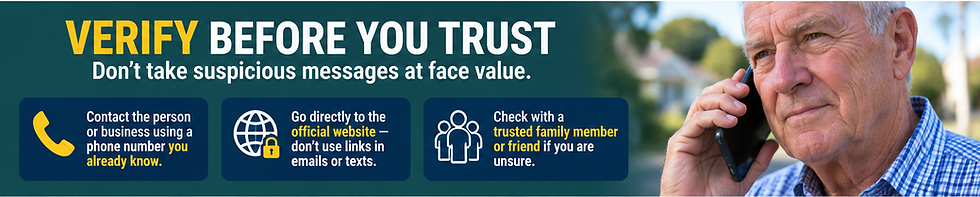
Verify unusual requests using a second communication channel.
If a supplier emails advising that its bank account details have changed, don't simply reply to the email.
Call the supplier using a telephone number you already know or obtain independently.
If your manager unexpectedly asks you to transfer money, confirm the request directly.
If your bank contacts you unexpectedly, don't use the telephone number or link contained in the message. Contact the bank through its official app, website or published telephone number.
The Australian government's scam-prevention message summarises this approach well:
Stop. Check. Protect.
Five Practical Protections for Australian Businesses
Australian businesses can substantially reduce their exposure by implementing several relatively simple controls:
Use multi-factor authentication.
Email accounts should not rely on passwords alone.
Create a formal bank-detail verification procedure.
Any request to change supplier or employee banking details should require independent verification.
Introduce additional approval for significant payments.
A second person reviewing large or unusual transactions can interrupt a scam before money leaves the business.
Train employees to recognise manipulation, not just suspicious emails.
Modern scams may involve genuine email accounts, convincing language and information gathered from previous correspondence.
Make reporting suspicious activity easy.
Employees should feel comfortable questioning unusual requests, including requests that appear to come from management.
Families Can Help Protect Older Australians
Families also have an important role.
Scam awareness should be based on something other than telling older relatives to distrust the internet.
That approach can be counterproductive.
Modern scams can fool intelligent and experienced people because the criminals behind them deliberately exploit normal human behaviours, such as trust, urgency, fear, affection and authority.
A better approach is establishing a simple family rule:
Before transferring a significant amount of money to someone you've only met online, talk to someone you trust.
Similarly, check unexpected investment opportunities independently before you transfer money.
And if someone suspects they have been scammed, they should speak up quickly.
Embarrassment helps scammers.
Rapid action may help banks, platforms and authorities prevent additional losses or identify the criminal infrastructure involved.
The Scale of the Problem has Changed
The emergence of industrial-scale scam centres should change how we think about online fraud.
The strange text message on your phone, the unexpected investment opportunity on social media, the convincing email apparently sent by a supplier and the friendly stranger who starts a conversation online may seem completely unrelated.
Behind them can be sophisticated international criminal networks operating infrastructure designed specifically to identify, manipulate and defraud people.
Australia therefore isn't dealing simply with nuisance emails or opportunistic fraud.
We are dealing with a global criminal industry.
For businesses, this means they must increasingly combine cybersecurity controls with staff awareness, payment verification, and strong internal procedures.
For individuals — particularly older Australians — awareness and independent verification remain among the strongest defences available.
Before trusting an unexpected request involving money or personal information:
Stop. Check. Protect.
Arafura Consulting & Media assists Australian businesses and home users with cybersecurity, Microsoft 365, endpoint protection and practical technology solutions designed to reduce their exposure to online threats.


Comments